Bavarian Alps
Germany's highest peaks, from the Zugspitze to the Watzmann.
.jpg)
- Elevation
- 705 m
- Nearest station
- Garmisch-Partenkirchen
The Zugspitze, on the Austrian border above Garmisch-Partenkirchen, is Germany’s highest mountain at 2,962 metres. A cogwheel railway, the Bayerische Zugspitzbahn, has climbed from the valley since 1930; since the Rosi Tunnel opened in 1987 it has ended at the Zugspitzplatt, at about 2,600 metres and about 360 metres below the summit, from which a cable car, the Gletscherbahn, finishes the climb. The mountain sits in the Wetterstein range, one of several separate limestone massifs that make up what is loosely called the Bavarian Alps: a strip of high ground along the Austrian frontier rather than a single continuous chain.
Berchtesgaden and the Watzmann
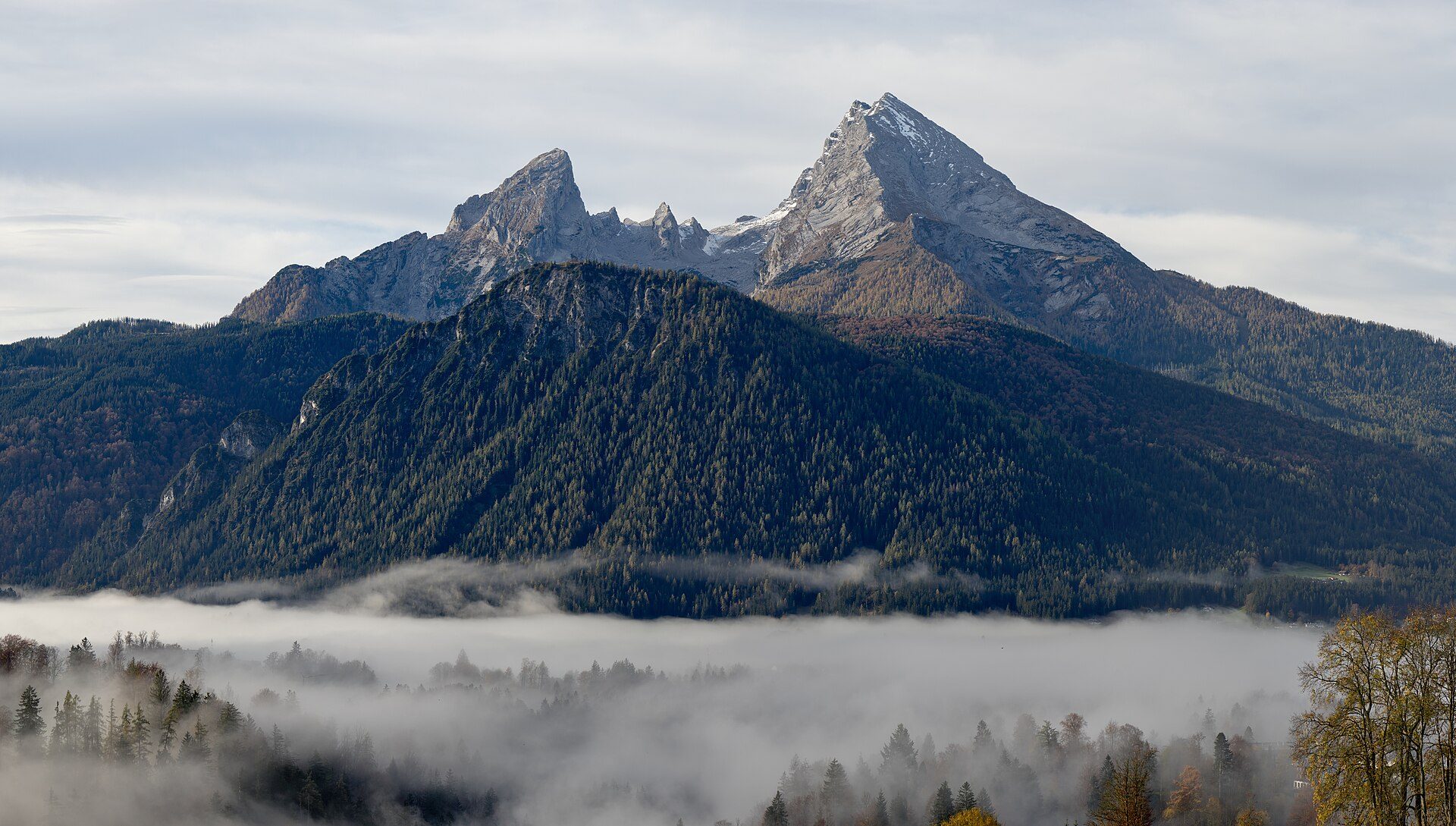
East of Garmisch, close to the Austrian city of Salzburg, the Berchtesgaden Alps form a second cluster. Berchtesgaden National Park, established in 1978, is Germany’s only national park inside the Alps, and it includes the Watzmann massif. The Watzmann’s central summit, the Mittelspitze, reaches 2,713 metres, which makes the mountain the third highest in Germany, and its traverse across all three summits is very exposed and rated at the easier end of UIAA Class II. Below the mountain lies the Königssee, a narrow, fjord-like lake whose passenger boats are electric, which the operator dates to 1909.
Castles, an abbey and a play
The Bavarian Alps are also where Ludwig II of Bavaria built the only one of his palaces he lived to see finished. Linderhof, completed in 1878 in a side valley near Ettal, is smaller and more private than his unfinished Neuschwanstein, which stands further west, in the Allgäu. Nearby, Ettal Abbey was founded in 1330 by the Holy Roman Emperor Louis the Bavarian, and its Baroque church, rebuilt after a fire in 1744, belongs to a Benedictine monastery that is still in use. The village of Oberammergau, close by, has staged its Passion Play since 1634, in fulfilment of a vow made, according to local legend, during a plague epidemic, and now performs it in years ending in zero.
Walking the region
The Watzmann Hut, owned by the Munich section of the German Alpine Club at about 1,930 metres, is where walkers typically spend the night before climbing the Watzmann. Above Garmisch, the Wetterstein has a good network of cable cars and lifts. Berchtesgaden, at the eastern end, has its own station at the end of the line from Freilassing, served by the Bayerische Oberlandbahn as line S4 of the Salzburg S-Bahn.
Getting here
The German Alpine Road (Deutsche Alpenstraße), which its marketing body calls Germany's oldest holiday road, runs along the Alps from Lindau on Lake Constance to the Königssee near Berchtesgaden and carries no tolls.