Black Forest
Gentle wooded hills in the north, higher ground in the south.

- Nearest station
- Titisee
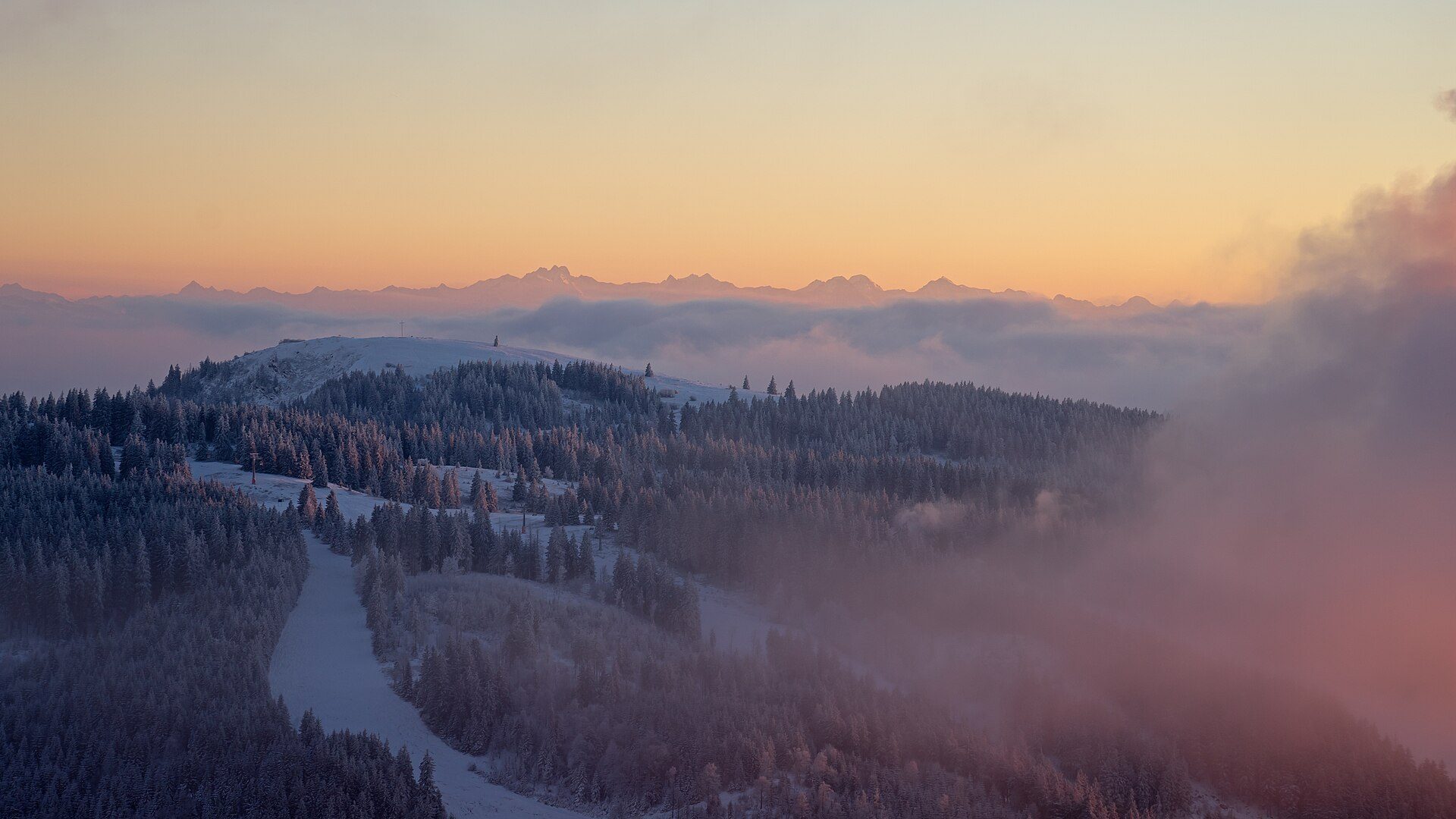
The Black Forest runs from the Kraichgau in the north to the High Rhine in the south, and its northern and central parts are the gentler half: rolling, densely wooded ridges cut by narrow valleys and small spa and clockmaking towns. The Southern Black Forest, toward the Swiss border, is much higher, rising to the Feldberg at 1,493 metres, the highest point in the Black Forest and the highest anywhere in Germany outside the Alps.
Baden-Baden and Calw
Baden-Baden, on the range’s north-western edge, has been a spa town since Roman times: the Roman baths there date to the reign of the emperor Caracalla in the early third century, and the modern Caracalla Therme takes his name. It is one of three German towns, with Bad Kissingen and Bad Ems, recognised by UNESCO in 2021 among the “Great Spa Towns of Europe”. Calw, in the Nagold valley of the northern Black Forest, is the birthplace of the novelist Hermann Hesse, born there in 1877.
Triberg and the Schwarzwaldbahn
Triberg, in the central Black Forest, is best known for its waterfalls, which drop 163 metres in a series of stages and are often claimed to be Germany’s highest, although the Röthbachfall near the Königssee in the Alps, at 470 metres, is taller. The town sits on the Schwarzwaldbahn, a railway engineered by Robert Gerwig and completed in 1873 between Offenburg and Singen. To climb 650 metres without excessive gradients, Gerwig routed the line through 39 tunnels, adding reversing tunnels and, to lengthen the route, two double loops in the Gutach valley near Triberg. The surrounding district was also a centre of Black Forest clockmaking: around 1840 the district between Neustadt and St. Georgen held about 1,000 clockmakers’ cottages employing some 5,000 people, and Germany’s first clockmaking school was founded in nearby Furtwangen in 1850.
Feldberg and the south
Titisee, a spa town on a glacial lake at 840 metres, is a base for the southern Black Forest and lies east of the Feldberg, whose summit is not wooded even though it stays below the natural tree line, which in this region would lie at around 1,650 to 1,700 metres. Freiburg im Breisgau, the fourth-largest city in Baden-Württemberg, lies at the range’s southwestern edge, where the Höllentalbahn to Titisee and Donaueschingen meets the Rhine Valley Railway. The Westweg runs about 285km from Pforzheim to Basel; the Baden section of the Schwarzwaldverein created it in 1900, and it became the model for many other long-distance trails.
Getting here
The B500, known as the Schwarzwaldhochstraße (Black Forest High Road), runs about 60 km along the high ridge between Baden-Baden and Freudenstadt. Completed in 1952, it is one of Germany's oldest scenic routes.