Rhine Valley & Mosel Valley
Wine valleys, not mountains, with two long-distance trails.

- Nearest station
- Koblenz
The Rhine and Mosel valleys are not a mountain region. Both are steep-sided river valleys, terraced with vineyards, cut through the slate of the Rhenish Massif, and the two rivers meet at Koblenz, at the confluence point known as the Deutsches Eck. What draws walkers is the ground above the vines: the walls of the Rhine Gorge rise about 200 metres above the water, and the two valleys are followed by two of Germany’s established long-distance footpaths.
The Rhine Gorge
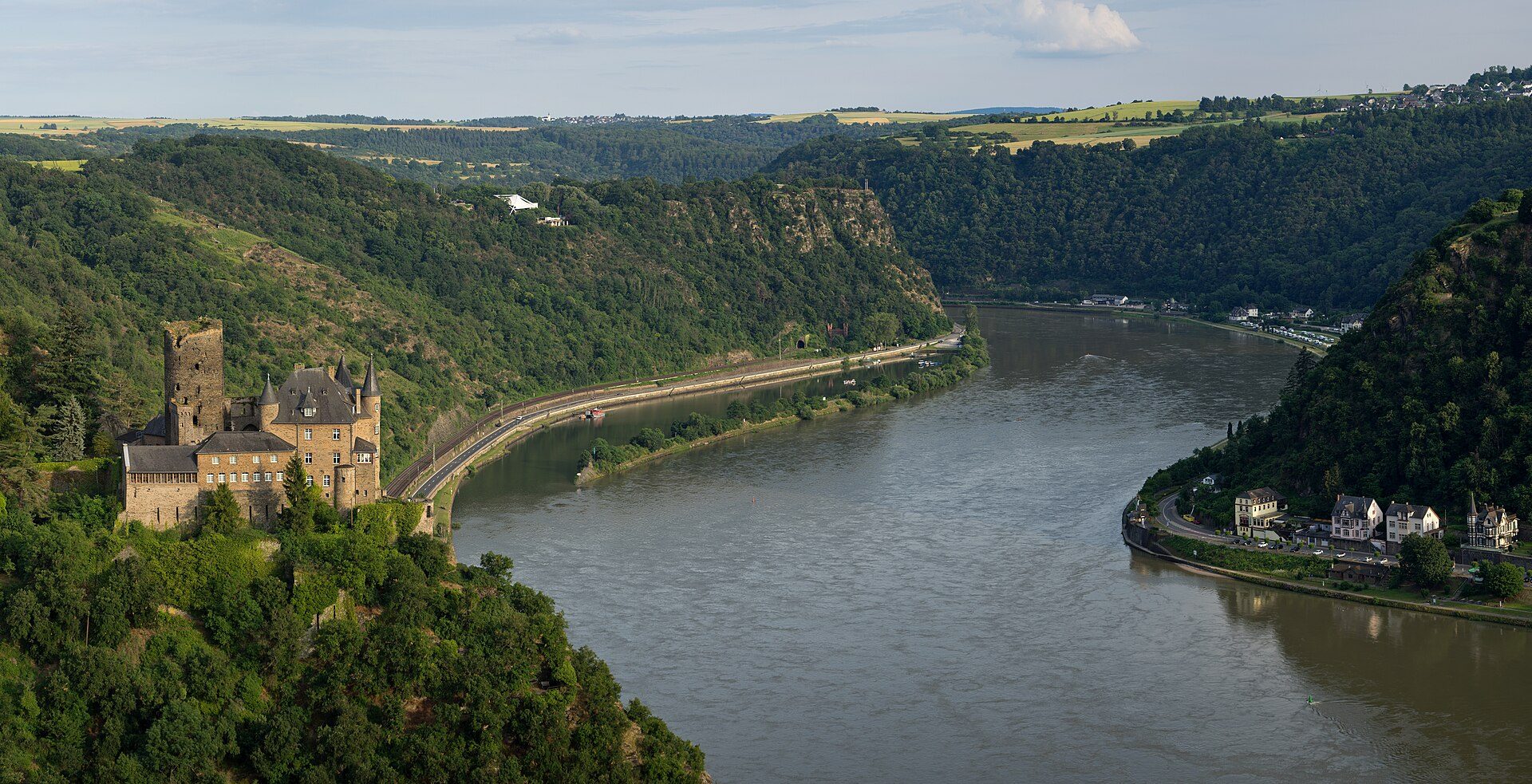
Between Rüdesheim and Koblenz, a roughly 65-kilometre stretch of the river known as the Upper Middle Rhine Valley has been a UNESCO World Heritage Site since 2002, recognised as a cultural landscape of terraced vineyards, hilltop castles and a river that has carried trade across Europe since prehistoric times. Its narrowest and deepest point is at the Loreley, a slate rock 132 metres high on the east bank near St. Goarshausen, associated since Clemens Brentano’s ballad of 1801 with a siren-like figure luring boatmen onto the rocks below. The Rheinsteig footpath is a mainly elevated path along the east bank, 320 kilometres between Wiesbaden and Bonn, with challenging ascents and descents.
The Mosel
On the Mosel, the Bremmer Calmont near the village of Bremm is commonly described as the steepest vineyard in Europe, with slopes reported at up to 68 degrees; the Calmont-Klettersteig, a via ferrata laid out by the German Alpine Club and opened in 2002, climbs the Calmont. The Moselsteig footpath runs 365 kilometres in 24 stages between Perl, on the Upper Mosel, and Koblenz. Trier, the first city the trail reaches after Perl, holds the Porta Nigra, which its tourist office calls the best preserved Roman city gate north of the Alps, part of the Roman monuments of Trier that UNESCO listed in 1986. Further downstream, Burg Eltz stands on a 70-metre rock spur above the Elzbach, a tributary of the Mosel; unlike many castles in the region, it was never destroyed and has belonged to the same family for more than 800 years.
Getting here
Railways follow both banks of the Rhine, the Left Rhine line on the west bank and the Right Rhine line on the east, and the Mosel line runs from Koblenz to Trier.