Salzburg & Salzburgerland
Salt, Mozart, and the northern side of the Hohe Tauern.

- Elevation
- 424 m
- Nearest station
- Salzburg Hauptbahnhof
Salzburg the city gives its name to Salzburgerland, the state around it, and the name comes from salt: it derives from the barges carrying salt on the Salzach, which paid a toll in the eighth century. Mozart was born in Salzburg in 1756, and the old town’s baroque churches and squares date largely from the 17th century, when Italian architects, and Austrians who had studied the baroque style, rebuilt the centre under the prince-archbishops, whose archbishopric Napoleon secularised in 1803.
South into the mountains
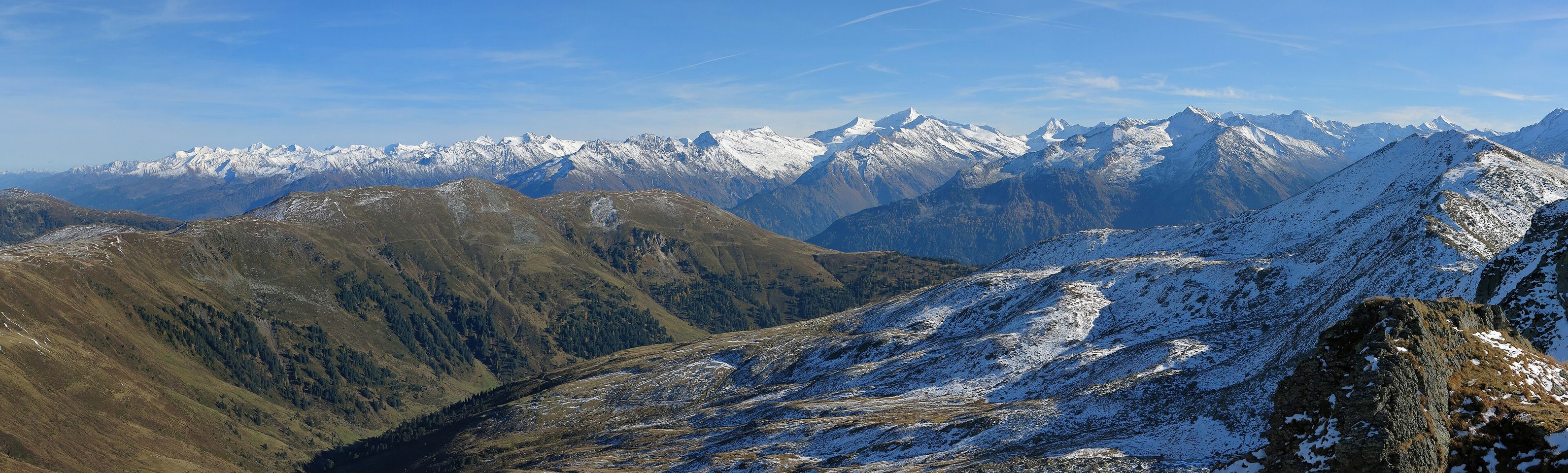
The Alpine divide, with the Hohe Tauern and numerous three-thousanders, runs through the south of the state. The Hohe Tauern hold the highest peaks east of the Brenner Pass and the Hohe Tauern National Park, at 1,856 square kilometres the largest national park in the Alps. It was established in stages rather than at once: Carinthia designated its share first, in 1981, Salzburg followed with a law of 1983, and Tyrol’s share came in 1992. Salzburgerland’s own high point is Grossvenediger (3,657 m on the Austrian survey office’s map), on the border with East Tyrol; Grossglockner itself, Austria’s highest mountain, sits just outside the state on the Tyrol-Carinthia line, though the Grossglockner High Alpine Road that crosses the range starts on the Salzburg side, at Bruck on the Grossglockner Road, with its cash desk at Fusch/Ferleiten. Tickets for the road are priced by vehicle, and it is open from the start of May until the start of November.
Towns and lakes
Zell am See lies in the Kitzbühel Alps on its own lake, the Zeller See, which covers 4.7 square kilometres. Kaprun, at the foot of the Kitzsteinhorn glacier on the northern slopes of the Glockner Group, presents itself with Zell am See as one tourist destination and ski area, and Saalbach-Hinterglemm, in the Glemm valley of the Kitzbühel Alps, is known for its skiing. Wolfgangsee, larger again at about 13 square kilometres, lies mostly within Salzburg but is one of the best-known lakes of the Salzkammergut, the lake-and-mountain region that continues into Upper Austria and Styria. The Dachstein massif and the Berchtesgaden Alps, the latter shared with Bavaria, border the state to the east and north.
Walking and season
Salzburg Hauptbahnhof is the main rail gateway: the Salzburg-Tyrol Railway runs from there by way of Hallein, Bischofshofen and Schwarzach-St. Veit to Zell am See, and on to Wörgl in Tyrol. A narrow-gauge line, the Pinzgauer Lokalbahn, follows the Salzach valley for 53km from Zell am See to Krimml, which is known for its waterfalls.