Salzkammergut
Lakes and salt-mining history, shared by three Austrian states.
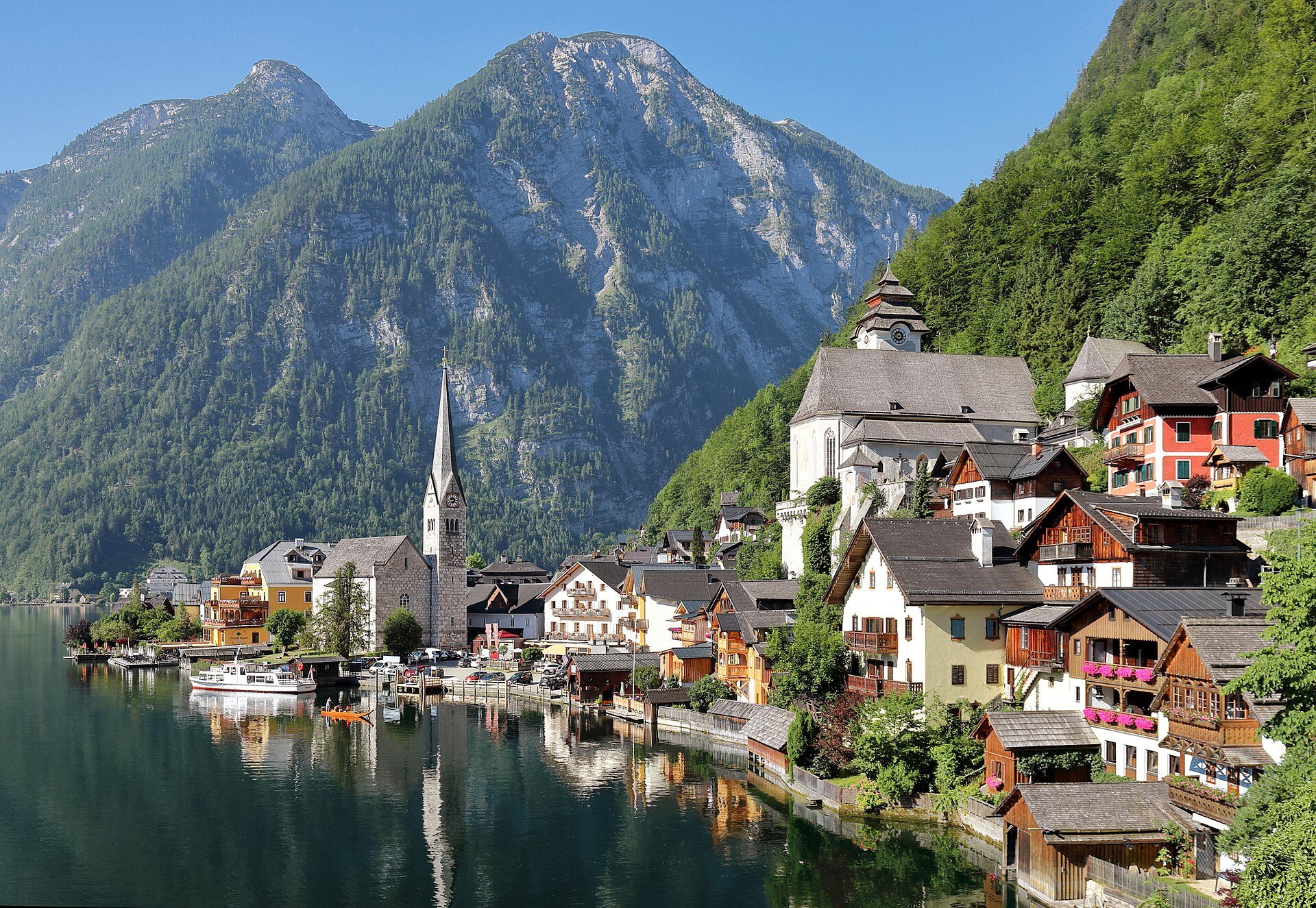

- Elevation
- 468 m
- Nearest station
- Bad Ischl
The Salzkammergut is not one of Austria’s federal states; it has no official borders and is shared between parts of Upper Austria, Styria and Salzburg. Bad Ischl, in the centre of the region, is a spa town whose Kaiservilla, given to Emperor Franz Joseph I in 1854 and described by him as “Heaven on Earth”, became the imperial family’s summer residence; he reigned from 1848 to 1916.
Salt, lakes and a World Heritage listing
The name Salzkammergut translates as “salt demesne” or “salt domain”, and salt has been mined at Hallstatt since around 1500 BC, which the Natural History Museum Vienna, whose researchers work the site, gives as making the Hallstatt salt mines the oldest in the world. In 1997 most of the historic cultural landscape of the inner Salzkammergut, the area of Bad Goisern, Hallstatt, Gosau and Obertraun, was listed by UNESCO as the Hallstatt-Dachstein / Salzkammergut Cultural Landscape. The region’s tourist board counts 76 lakes; Attersee, at 46.2 square kilometres, is the largest inland lake in Austria, ahead of the Traunsee at 24.5.
The Dachstein and its via ferratas
The mountains sit at the region’s southern edge, where the Hoher Dachstein rises to 2,995 metres on the border between Upper Austria and Styria, the highest point of both states; the official measurement of the Austrian survey office (BEV) is 2,995.01 metres, and parts of the massif also lie in Salzburg. Its limestone flanks carry via ferrata routes (Klettersteige); the Schladming-Dachstein region on the Styrian side lists more than 33, in all grades from A to E.
European Capital of Culture, 2024
In 2024 Bad Ischl was the banner city of the European Capital of Culture, a title shared by 23 communities in Upper Austria and Styria, and the first time, the region’s tourist board says, that the title went to the inner Alpine region.
Getting there
Bad Ischl has its own station on the Salzkammergut railway line, which ÖBB runs between a junction near Schärding and Stainach-Irdning and which meets the Western Railway at Attnang-Puchheim. Hallstatt’s station is on the opposite side of the lake from the village; a ferry waits for every train arrival and departure and takes passengers across to the historic centre. The lakes are used for sailing, surfing and diving, the tourist board says of the Attersee.