Wachau Valley
A Danube wine valley, honestly not a mountain one.

- Elevation
- 209 m
- Nearest station
- Melk
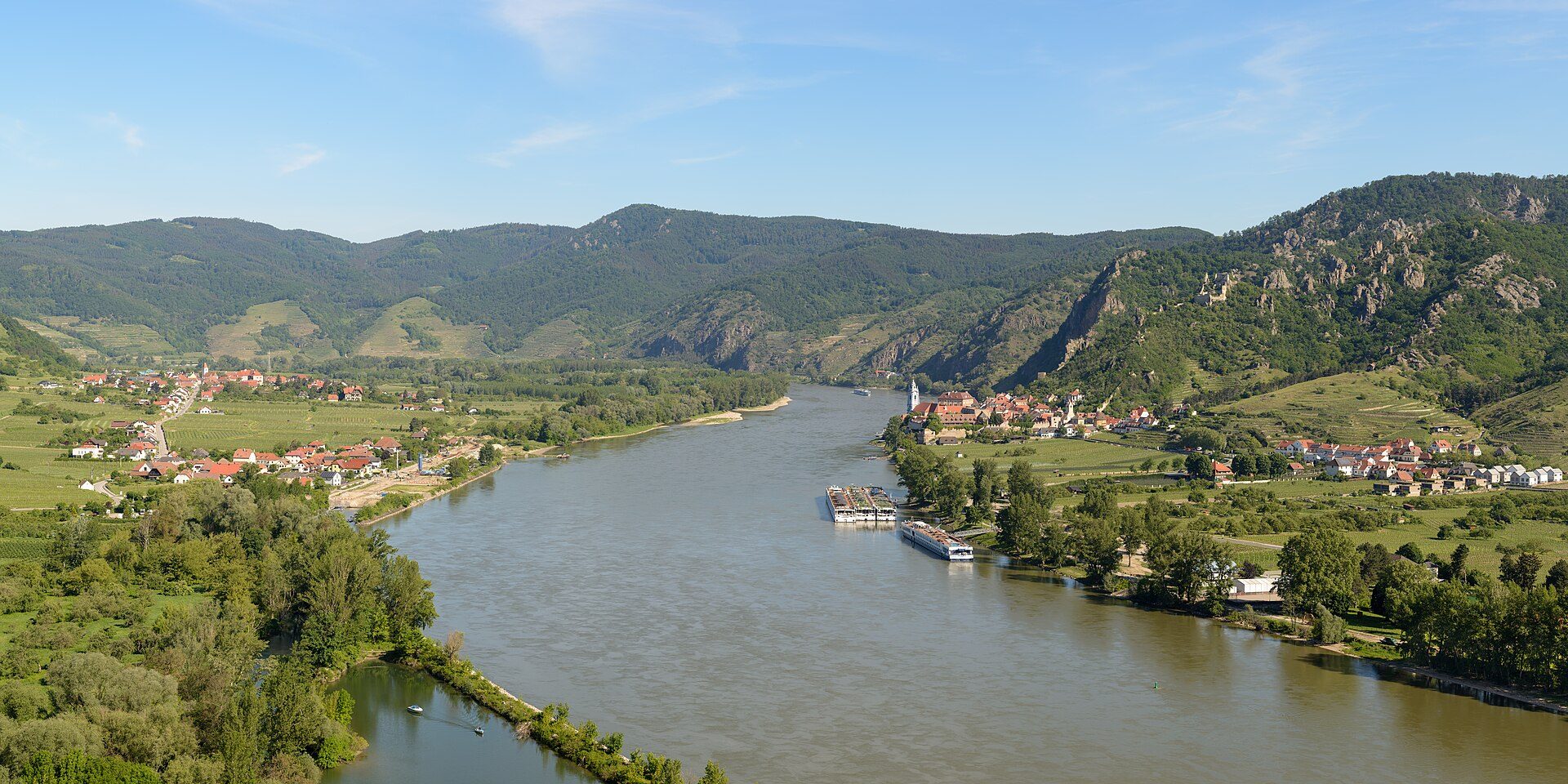
The Wachau is a wine valley, not a mountain region. It is a 36-kilometre stretch of the Danube between Melk and Krems an der Donau in Lower Austria, where the river cuts through the southern tip of the Bohemian Massif, an upland of granite and gneiss, with vines grown mostly on stone terraces on the slopes. UNESCO inscribed it as the Wachau Cultural Landscape in December 2000, in recognition of its architectural and agricultural history: the terraces, the historic towns, and the monasteries and castle ruins above them.
What there actually is to see
Melk Abbey, a Benedictine abbey founded in 1089 when Margrave Leopold II gave one of his castles to monks from Lambach, was rebuilt in its Baroque form between 1702 and 1736 to designs by Jakob Prandtauer and stands on a granite outcrop above the town of Melk, where the Wachau begins. Dürnstein, where the Danube turns toward Krems, is built below the castle in which Duke Leopold V held King Richard I of England captive in 1192, after their dispute during the Third Crusade; Swedish troops almost completely destroyed the castle in 1645. Riesling and Grüner Veltliner are named, with Neuburger, among the Wachau’s wine specialities, grown on steep stony terraces.
The genuine walking interest
The Welterbesteig Wachau (Wachau World Heritage Trail) is a long-distance trail of 180 kilometres in 14 stages, running on both sides of the Danube, and it holds the Austrian hiking quality seal, the Österreichisches Wandergütesiegel. It runs through meadows, forest, orchards and vine terraces and the historic towns rather than open mountain country, and the regional tourist board says that numerous ferries make it easy to change banks. The flatter Donauradweg cycle path has stages on the north and south banks of the same river.
The nearest real mountains
In south-western Lower Austria the Alps proper begin; the Ötscher, in the Ybbstal Alps of the Northern Limestone Alps, reaches 1,893 metres. The Wachau’s own highest ground is the Jauerling, at 960 metres. The preferred tourist season runs between Easter and All Saints: the apricot blossom comes in spring, summer is hot, and the vine harvest falls in autumn. The regional tourist board names Krems and Melk as the nearest stations, with bus lines 715 and 720 between them along both banks and the Wachaubahn on the north bank.
Getting here
The Donauradweg cycle path has stages on both the north and south banks of the Danube, and ferries let you cross the river without a car.