Eastern Switzerland
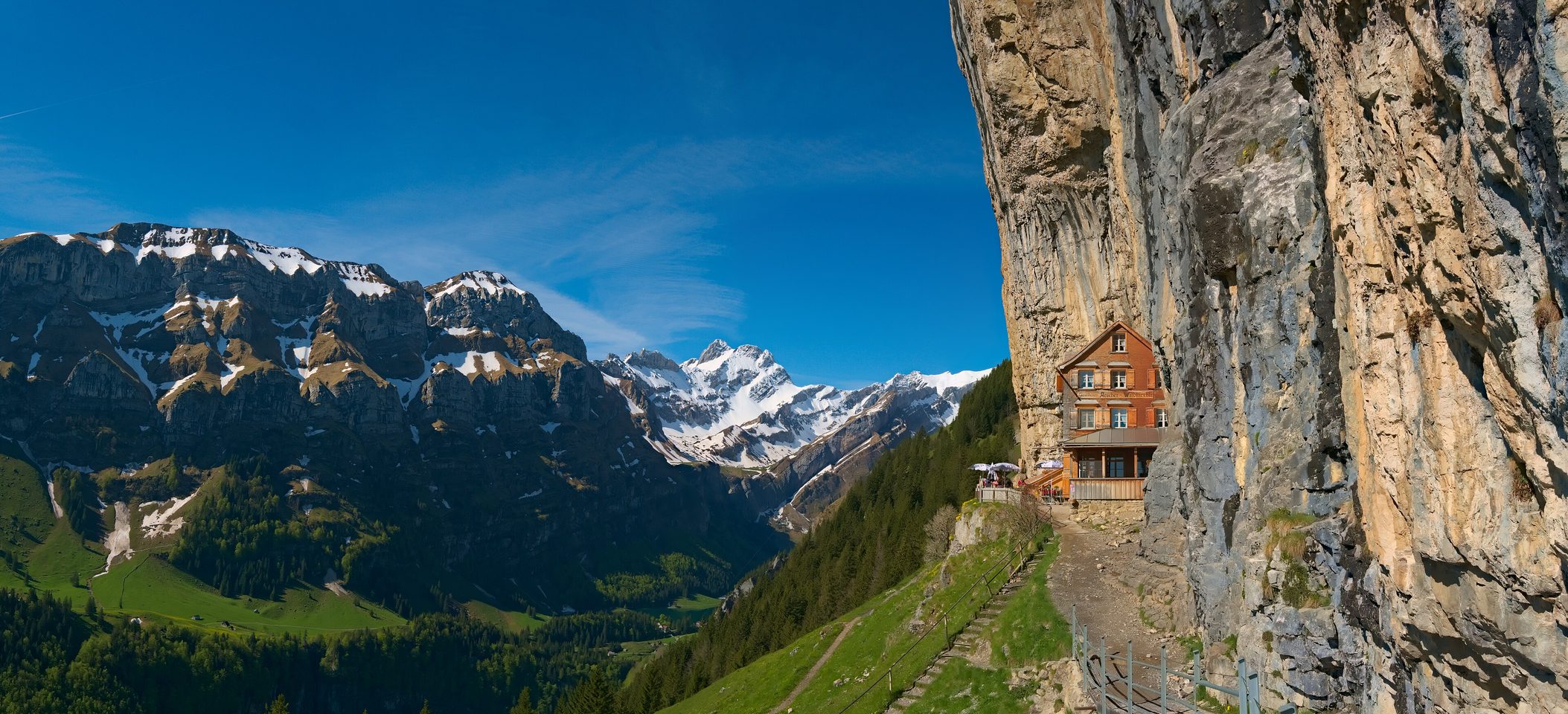
Appenzell's Alpstein and the Glarus Alps, east of Zürich.

- Nearest station
- Appenzell
Appenzell and the Alpstein
Eastern Switzerland is the block of the country east of Zürich and north of Graubünden, lower and less glaciated than the classic high Alps further south but with mountain walking of its own. Its best-known range is the Alpstein, a compact limestone massif rising abruptly from the rolling farmland of Appenzell, crowned by Säntis (2,502m), the meeting point of three cantons, Appenzell Ausserrhoden, Appenzell Innerrhoden and St. Gallen, a landmark visible far enough that houses called Säntisblick stand as far away as the Black Forest, with six countries in view from the summit if the weather allows. Appenzell itself is the small capital of Appenzell Innerrhoden, a canton that has preserved many old customs and costumes.
Toggenburg and Glarus
Southwest of Appenzell, the Toggenburg, the upper valley of the Thur, runs between the Säntis chain of the Alpstein and the Churfirsten, a limestone ridge of seven main peaks. Further south again, canton Glarus, whose capital is Glarus, rises to Tödi (3,614m), the highest peak in the Glarus Alps and the highest point in the canton, on the border with Graubünden. The Swiss Tectonic Arena Sardona, across the cantons of Glarus, St. Gallen and Graubünden, is a UNESCO World Heritage Site in its own right, inscribed in 2008 for geology rather than scenery: the Glarus thrust, a major fault along which older Permo-Triassic rock layers were thrust over younger Jurassic and Cretaceous limestone, visible in places such as the Tschingelhörner as a horizontal line in the cliffs.
Heidiland and Lake Constance
To the north, the region’s border is Lake Constance, the Bodensee, shared with Germany and Austria, flat and lake-focused rather than mountainous. Toward Graubünden, the stretch of the Rhine valley around Maienfeld is called Heidiland, after Johanna Spyri’s novel, which is set there. None of this region reaches the scale of the Bernese Oberland or Valais, and it does not pretend to: Säntis is 2,502m and Tödi 3,614m, against the Jungfrau’s 4,158m. Without a car, the Säntis cable car’s valley station at Schwägalp is a PostAuto ride from Urnäsch, on the Appenzeller Bahnen, or from Nesslau, and the Ebenalp cable car starts at Wasserauen, the end of the Appenzell Railways line from Gossau.