Lake Lucerne
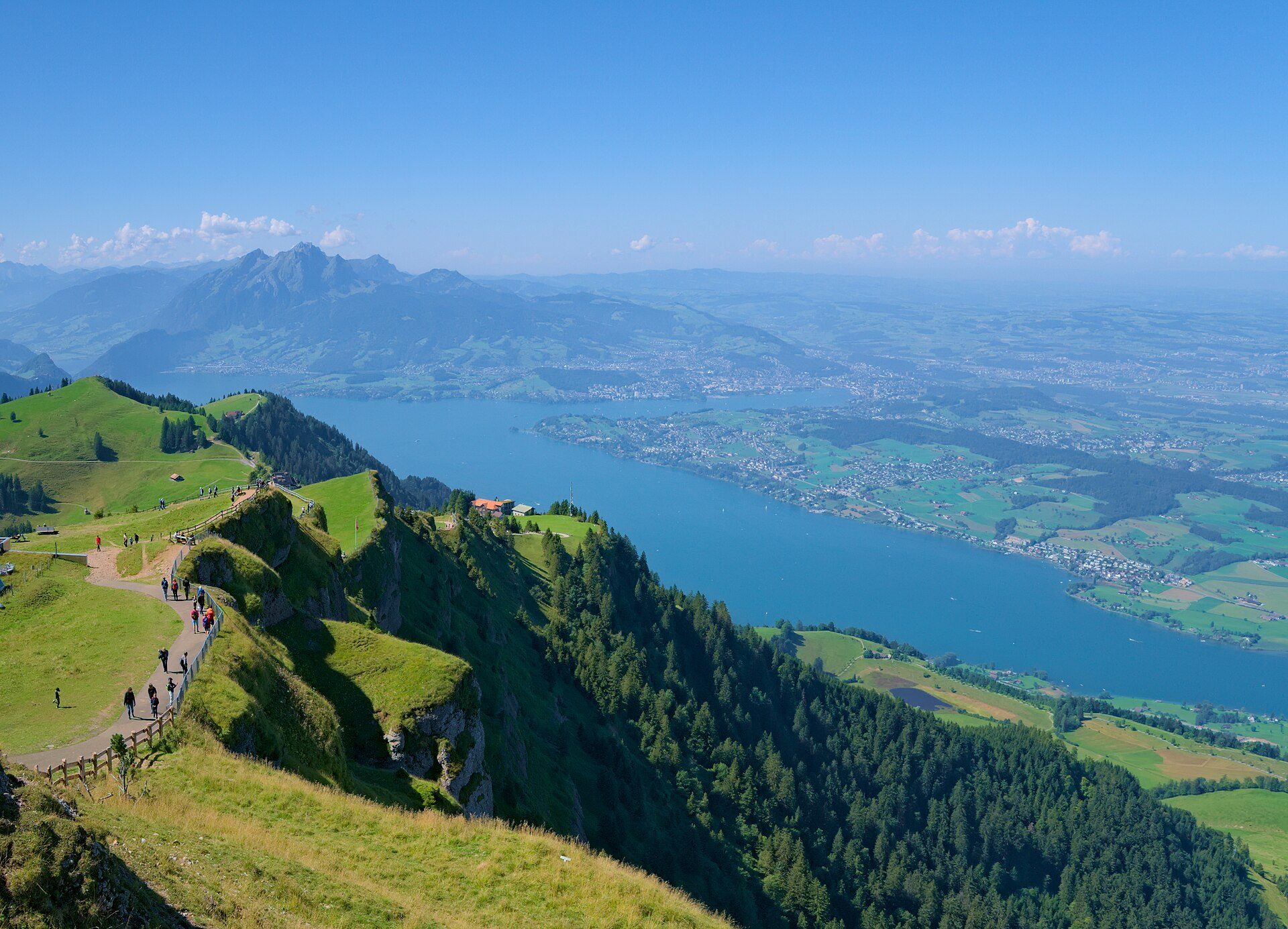
Pilatus and Rigi above the water, reached by two historic railways.

- Elevation
- 435 m
- Nearest station
- Luzern
The lake of the four forest cantons
Lake Lucerne’s German name, Vierwaldstättersee, describes it more usefully than the English: the lake of the four forest cantons, named for Uri, Schwyz and Unterwalden, the three founding cantons of the Swiss Confederacy, and Lucerne, which joined them in 1332, all of whose shores it touches. Its shape, branching and irregular rather than a simple oval, was formed at the end of the last ice age from the meltwater of the Reuss Glacier, giving a freshwater fjord with four arms and several sharp bends that reveals a different view around almost every headland. On a mountain meadow above its Uri arm, Rütli, Swiss tradition places a legendary founding oath, traditionally dated to 1307 and sworn by representatives of Uri, Schwyz and Unterwalden; the surviving document is the Federal Charter of 1291, dated to early August, and the meadow remains the site of the Swiss National Day celebration on 1 August.
Pilatus and Rigi
Two mountains face each other across the lake and dominate it: Pilatus, 2,128m at its highest point, Tomlishorn, overlooking Lucerne, and Rigi (1,798m) on the north shore, known for generations as the “Queen of the Mountains”. Both are reached by historic mountain railways built for exactly that purpose. The Pilatus railway, opened in 1889 from Alpnachstad, climbs at a gradient of up to 48 percent and remains the steepest cogwheel railway in the world, while the Rigi railway, opened in 1871 from Vitznau, was the first mountain railway built anywhere in Europe. The railways make them an easy add-on to a day on the lake rather than a dedicated hiking objective, though both also carry trail networks for anyone who wants to walk rather than ride.
Walking and access
The lake is best explored by a mix of boat and train: paddle steamers still cross it on scheduled routes, connecting Lucerne to Vitznau, Weggis and the villages on the Uri arm, and most walking routes in the area are built around reaching a station or a jetty at one end. Away from Pilatus and Rigi, the Bürgenstock, a mountain of 1,128m beside the lake, has the Felsenweg cliff path and the Hammetschwand lift, which MySwitzerland calls the highest outdoor lift in Europe, with a view of Lake Lucerne and the Alps. Lucerne itself, at the lake’s outfall into the Reuss, is the main rail hub, with lines from Zürich and from Bern, and the paddle steamers and smaller lake boats depart from the quay beside the station. The Pilatus railway starts at Alpnachstad, where it meets the lake steamers and the Zentralbahn’s Brünig line, and the Rigi has two railways, from Vitznau on the lake and from Arth-Goldau.